Among the 268 possible tilings of a 12 x 12 square, there are 24 special tilings which are called
core tilings.
The moves (or interchanges) which allow us to go from one of these to another one are examples of
global moves .
In any such more, exactly two of the four right triangles are interchanged
(never turning triangle 1 over, and always keeping it above the center line of the square).
From each core tiling there are at least 4 (and sometimes as many as 17) other tilings which can be reached by
using what we call local moves. These are moves which interchange pieces by reflecting or rotating
(usaully small) symmetric subconfigurations. More precisely, these symmetric
arrangements will always be squares, rectangles or isoceles triangles or trapezoids.
The set
of tilings reachable this way from a core tiling T will be called the
cluster associated to T.
Here is an example of the cluster 1234 and its intra-cluster subgraph:
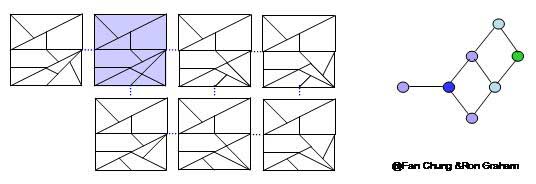
The core tilings (connected by global moves)
form a cluster graph. Of course, the actual STOMACH graph has each core vertex replaced by all the
tilings in its cluster, and all possible edges put in which correspond to allowable moves.
That is, within a cluster there are local moves and between clusters there are global moves.
Facts :
-
There are 268 vertices and 937 edges in the STOMACH graph.
-
The giant connected component contains 266 vertices and 936 edges
while the minor component has only one edge and two vertices!
-
In the giant component,
there are
409 intra-cluster edges (local moves)
and 527 inter-cluster edges (global moves).
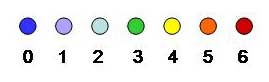
Note that the vertices in the cluster graph are colored according to the distance to the core.
The color scheme
is as follows:
 More
More